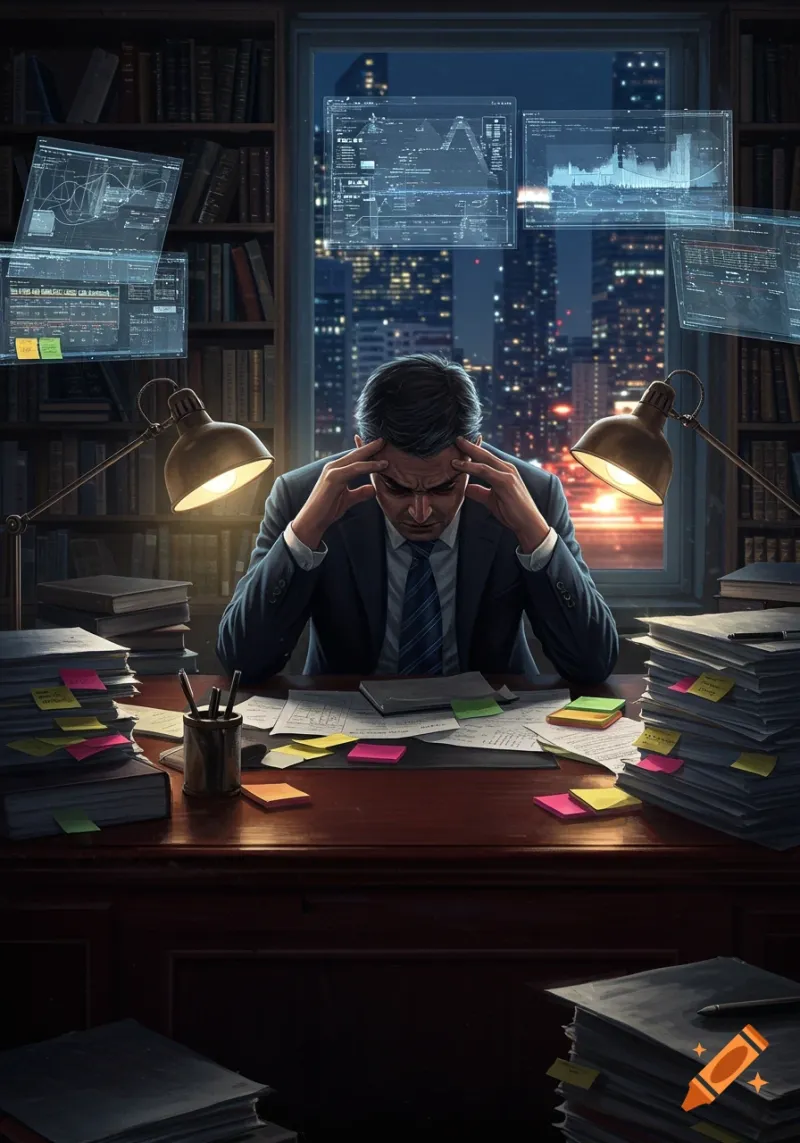
Nobody's Home: How Creators Started Writing for an Audience That Doesn't Exist

Photo: Eden, Janine and Jim from New York City, CC BY 2.0, via Wikimedia Commons
Picture someone sitting down to write a newsletter. They have maybe 400 subscribers. Real people — some of them friends, some of them strangers who found the thing organically, some of them colleagues. A small, specific, genuinely interested group.
But when they sit down to write, who are they actually writing for?
Not the 400. Not really. They're writing for the version of the newsletter that has 40,000 subscribers. They're writing for the person who might share it, for the algorithm that might surface it, for the hypothetical reader who arrives six months from now via a tweet that hasn't been posted yet. They're optimizing for a future audience at the expense of the present one.
This is happening everywhere. And it's one of the quieter ways the internet is eating itself.
The Audience You Can't See
Every platform that tracks engagement creates a ghost problem. You can see likes, shares, open rates, click-throughs. What you can't see — what's genuinely invisible — is the lurker. The person who reads everything and responds to nothing. The subscriber who's been there since the beginning and has never once hit reply. The follower who recommends your work to people in real life and leaves zero digital trace.
Studies on online community behavior consistently find that a tiny fraction of users generate almost all visible engagement. The commonly cited figure is something like 90% of users are passive consumers. Which means for most creators, the feedback they're receiving — the data that shapes their decisions — is coming from a wildly unrepresentative slice of their actual audience.
And here's where it gets interesting: the visible minority isn't just unrepresentative in size. It's often unrepresentative in kind. Heavy engagers tend to be more extreme in their opinions, more likely to be other creators, more likely to be optimizing their own engagement by engaging with yours. They're not your typical reader. They're a specific, weird, self-selected subset.
But they're the only ones you can hear. So you start writing for them.
Optimizing Into Oblivion
The logic of optimization is seductive because it feels like improvement. You post something, you watch what performs, you do more of that. Seems rational. The problem is that "what performs" is a measurement of a measurement — you're tracking the response of the visible minority to surface content to a hypothetical future audience, and using that to make decisions about your actual work.
At each step, you're moving further from the original thing you were trying to say.
This process has a particular character in niche spaces, which is worth sitting with. The whole promise of niche content is specificity — that you can be weird and particular and not have to sand down your edges for a mass audience. But when niche creators start optimizing for engagement metrics, they end up sanding down their edges anyway, just for a different mass audience. The niche becomes its own kind of mainstream, with its own conventions and its own performance of authenticity that isn't actually authentic.
You see this on Substack. You see it in podcast communities. You see it in subreddits that started with genuine specificity and slowly became indistinguishable from content farms because the creators inside them started chasing the same signals. The niche homogenizes. The signal becomes noise.
Writing for the Algorithm Is Writing for Nobody
Let's be direct about what algorithmic optimization actually means in practice. When a creator adjusts their work to perform better in a recommendation system, they are not making decisions based on human beings. They are making decisions based on a statistical model of human behavior that was built on historical data that reflects the preferences of previous users who were themselves already responding to previous algorithmic optimization.
It's turtles all the way down. There's no actual person at the bottom of that stack.
The algorithm isn't a reader. It doesn't find things meaningful. It doesn't care if your essay changed how someone thought about their relationship or if your video made a 19-year-old feel less alone at 2am. It cares about predicted watch time and engagement probability. Those things correlate with human interest but they are not human interest. Treating them as the same thing produces content that feels vaguely like human interest without actually being it.
This is why so much content feels hollow even when it's technically competent. The craft is there. The voice is gone. Because the voice was the first casualty of optimization.
The Lurker as the Real Audience
Here's a reframe worth considering: the invisible audience — the lurkers, the quiet readers, the people leaving no trace — might actually be the most important audience a creator has. Not because they're numerous (though they are), but because they're the ones engaging with the work on its own terms rather than as a performance of engagement.
The person who reads your newsletter every week and never replies isn't disengaged. They might be the most genuinely engaged person in your list. They're not there to be seen being there. They're just there for the thing itself.
Creating for that person looks different than creating for the visible minority. It's slower. It's less legible to analytics dashboards. It doesn't generate the feedback loops that feel productive. But it's also the only kind of creating that produces work with genuine staying power, because it requires you to actually trust your own instincts rather than outsourcing your judgment to a metric.
Finding the Signal Again
There's no clean solution here. Platforms are built to make the invisible audience invisible. Analytics exist and creators will look at them. The feedback loop between performance data and creative decisions is baked into the infrastructure of every major content platform in the US.
But there are small acts of resistance worth naming.
Turning off public like counts, at least for yourself. Writing the thing that has no obvious audience before writing the thing that does. Responding to the person who emails you directly more than to the tweet that blew up. Building in deliberate periods of not checking performance data while creating.
None of these are radical. But they're ways of insisting, in small ways, that the work is for a real person — even if you can't see them, even if they never tell you they're there.
The ghost audience is real. It's just not the ghost most creators are haunting themselves with.