Quality Content Won't Save You: The Hidden Cognitive Cost of a Curated Feed
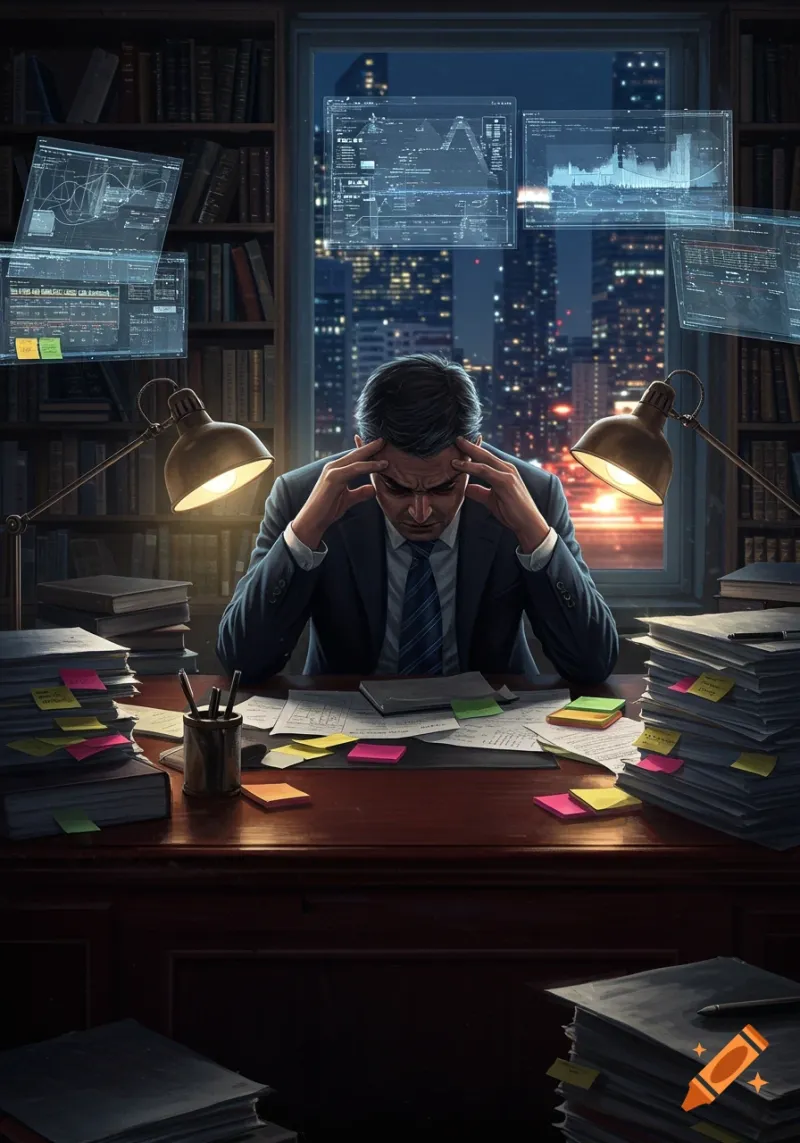
Photo: person overwhelmed reading multiple screens laptop coffee desk, via media.craiyon.com
Somewhere around 2021, a lot of people made a deal with themselves. They'd quit the doom-scroll. Delete Twitter, or at least mute the worst of it. Subscribe to smarter newsletters. Follow researchers instead of influencers. Curate their RSS feeds like a personal library. The logic was clean: bad inputs cause bad mental states, so better inputs should produce better ones.
Except the brain fog didn't really lift. The low-grade exhaustion at the end of a media-heavy day — it was still there. Just wearing a different outfit.
Here's the thing nobody tells you when you upgrade your content diet: the problem was never only about quality.
The Switching Cost Nobody Accounts For
Cognitive scientists have a term for what happens every time your brain shifts from one context to another: switching cost. It's the mental overhead of reloading a new frame of reference, a new set of stakes, a new vocabulary. When you move from a Substack essay about monetary policy to a podcast about mycology to a Discord thread debating the ethics of AI art, your brain isn't just absorbing three different topics. It's performing three separate context loads — each one burning a little fuel.
Algorithmic feeds turbocharged this problem by making context-switching invisible. You didn't choose to jump from a video about urban planning to one about ancient Rome. It just happened, and you barely noticed. But here's the twist: intentional curation doesn't automatically fix it. If you've built a reading list that spans geopolitics, independent film criticism, climate science, and long-form sports journalism, congratulations on your taste. Your brain is still paying a switching tax every single time you move between them.
The content got better. The architecture of consumption mostly didn't.
Decision Fatigue Is Hiding Inside Your 'Good' Habits
There's a second layer to this that's easy to miss. Better content ecosystems often come with more choices, not fewer. A well-curated Feedly account might have forty sources. A thoughtful podcast app might have twenty shows in rotation. Every time you sit down to consume something, you're making micro-decisions: what to read first, what to save for later, what to abandon halfway through, whether this piece is worth your full attention or just a skim.
Those micro-decisions accumulate. Decision fatigue is a real phenomenon — the mental bandwidth you spend on small choices is bandwidth you're not spending on anything else. The cruel irony is that people who care most about what they consume often build the most decision-heavy media environments for themselves. The casual doom-scroller just follows the algorithm. The intentional consumer has engineered a system that demands constant low-level management.
Neither one necessarily feels better at the end of the day.
What 'Mental ROI' Actually Means
Most people evaluate their media consumption by content quality. Was that article well-reported? Was that podcast guest actually an expert? Was that essay making a real argument or just vibes dressed up in big words? These are legitimate questions. But they're measuring inputs, not outcomes.
A more useful framework is something like mental ROI — what did you actually get out of a piece of content relative to what it cost you to consume it? And the cost isn't just time. It's attention load, context-switching overhead, decision fatigue, and the emotional residue the content leaves behind.
Some long, dense, challenging pieces of journalism are worth every bit of that cost. You finish them and feel genuinely expanded — like you can see something you couldn't see before. Others are technically high quality but leave you feeling vaguely unsettled or weirdly depleted, the way a big meal from a good restaurant can still make you feel gross if you ate too fast.
The question isn't just "was this good?" It's "how did this land in my head, and was that worth it?"
A Few Rough Heuristics
None of this means you should stop trying to consume better stuff. It means the optimization problem is more complicated than most productivity advice acknowledges. A few things that actually seem to help:
Batch by context, not by medium. Instead of jumping between a podcast, a newsletter, and a video in one sitting, try staying inside one general subject area for a block of time. Your brain can go deep instead of constantly reloading.
Track how you feel after, not just during. The engagement loop is designed to feel good in the moment. The more useful signal is how you feel twenty minutes after you've put your phone down. Restored? Agitated? Blank? That's your real feedback.
Smaller queues, not better queues. A reading list with eight items you're genuinely excited about is less cognitively expensive than one with eighty items you feel obligated to eventually get to. The obligation itself is a drain.
Build in actual blank time. This sounds obvious but it's genuinely rare. Not "I'll listen to something calm" time. Actual nothing. The brain needs periods with no incoming signal to consolidate what it's already processed. Filling every gap with quality content is still filling every gap.
The Structural Problem Isn't Going Away
The platforms — even the good ones, even the intentional ones — are still built around the idea that more consumption is better than less. Substack wants you to open more emails. Podcast apps surface new shows. Even tools designed for focused reading tend to gamify how much you're getting through.
The attention tax is baked into the infrastructure. You can work around it with some discipline and some self-awareness, but you can't opt out of it entirely just by choosing smarter sources. The brain doesn't get a free pass on cognitive overhead just because the content deserves one.
Knowing that doesn't make it easier, exactly. But it does mean you can stop blaming yourself when the good stuff still leaves you feeling a little wrung out. That's not a personal failure. That's just how expensive it is to actually pay attention.